
Honorary Doctor Luis García Montero: Owners of Our Own Conscience

Authors

Luis García Montero
Polytechnic University of Madrid
https://orcid.org/0000-0002-3387-4164

Keywords:

Honorary Doctor, Luis García Montero, University of Colima, poetry

Synopsis

The degree of Honorary Doctor is the most important distinction that the University of Colima grants and it is awarded to those who have contributed to the development of the sciences, the arts, and the humanities in a decisive manner. This book is a testimonial of the memorable visit of Luis García Montero to the University of Colima and includes a very brief, but significant, selection of his poetry. Conjunctly, this work expresses García Montero’s poetic conviction for building a free and fulfilled world by way of the universities, which he himself defined as the cultural spaces for human reflection, the management of knowledge, and the absolute liberty of learning. At the University of Colima, we subscribe to this commitment with humanities and education for the positive transformation of our reality.

Downloads

Download data is not yet available.

Author Biography

Luis García Montero, Polytechnic University of Madrid

Luis García Montero is a writer, poet, literary critic, and essayist. He was born in Granada, Spain, in December of 1958 and started his university career in the Faculty of Hispanic Philology at the University of Granada where he obtained his bachelor’s degree in 1980 and his PhD in 1985. He is a professor of Spanish Literature at the University of Granada and the Director of the Cervantes Institute of Spain. He is also a member of Generación de los Ochenta (Generation of the 80’s) or Postnovísmos, related to the La Otra Sentimentalidad (The Other Sentimentality) Contemporary Spanish Poetry Group, alongside Javier Egea and Álvaro Salvador.

Among his books of poetry are: A puerta cerrada (2017); No puede ser así. Breve historia del mundo (2021); and Un año y tres meses (2022). He has also collected a selection of his works in poetry. 1980-2017 (2018); Una melancolía optimista (2019) and Almudena (2024). He is also the author of the novels: Mañana no será lo que Dios quiera (2009), No me cuentes tu vida (2012), and Alguien dice tu nombre (2014). He has also collected a sellection of his Works in Almudena (2015); Poesía. 1980-2015 (2015); La buena compañía (2016); Poesía. 1980-2017 (2018) and Una melancolía optimista (2019).

In his facet as a literary critic and essayist, we may find the publications of Un lector llamado Federico García Lorca (2016), Las palabras rotas (2019), Un orden conflictivo (2019), Prometeo (2022), La realidad de una esperanza. Galdós, la memoria y la poesía (2023), and Más flexibles que el mar son las palabras (2023), among others. 

References

Sin referencias bibliográficas
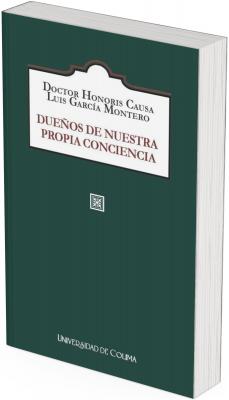
The cover features a solid dark green background, conveying seriousness, elegance, and sobriety—characteristics befitting a work of academic and philosophical significance. At the top, a white frame with a black and red border stands out, its classic shape reminiscent of a commemorative plaque or institutional poster, emphasizing the importance of the content. Within this frame, the text is structured as follows: “Doctor Honoris Causa” in black, serif, capital letters, indicating that the author has been awarded this honorary title. “Luis García Montero” appears directly below, in a prominent font, highlighting the honoree's name. The book's title, “Masters of Our Own Conscience,” is in red capital letters, making it the most striking element of the design and emphasizing the work's central concept.

Downloads

Published

November 25, 2024

Details about the available publication format: PDF

PDF

ISBN-13 (15)

978-607-8984-45-9

Publication date (01)

2024-11-25

Details about the available publication format: Printed version

Printed version

ISBN-13 (15)

978-607-8984-55-8

Publication date of print counterpart (19)

2024-12-10

Physical Dimensions

How to Cite

García Montero, L. (2024). Honorary Doctor Luis García Montero: Owners of Our Own Conscience. University of Colima. https://doi.org/10.53897/LI.2024.0046.UCOL