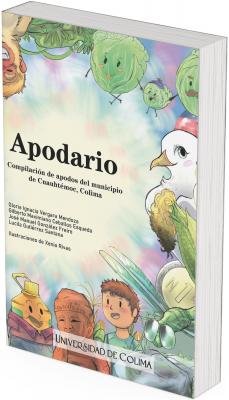
Nickname Guide: Compilation of Nicknames in the Municipality of Cuauhtémoc, Colima
Keywords:
Nicknames, municipalities, Cuauhtémoc, ColimaSynopsis
There are few studies which have been carried out in regards to nicknames, the people with nicknames, those who give out the nicknames, and the reason of why nickname them this or that way. Because of this, this book stands out whose relevance is due to expressive richness of the 250 monikers collected, and to the diverse angles from which its analytic approximation was carried out.
In this Nickname Guide, numerous and colorful monikers animate the onomastic landscape of the Municipality of Cuauhtémoc, Colima, and procure a verbally “nicknamish” image of the communities of Quesería, Cuauhtémoc, Alcaraces, Buenavista, and El Trapiche. The nicknames are classified and analyzed according to their geographic origin, accompanied by an informative file card which breaks down different perspectives such as the phonetic transcription, the typology, and an explanation provided by the informant of the origin of the nickname, among other aspects.
This book is the product of the research project called Los apodos de del occidente de México (The Nicknames of Western Mexico), in which participate the Academic Bodies 49, “Rescate del patrimonio cultural y literario” and 67, “Sociedad, cultura y significación”; of the University of Colima.
Downloads
References
Academia Mexicana de la Lengua. (2010). Diccionario breve de mexicanismos. Siglo XXI.
Alonso, M. (1960). Ciencia del lenguaje y arte del estilo. Aguiar.
Asociación de Academias de la Lengua Española. (2010) Diccionario de americanismos.
Beinhauer, W. (1973). El español coloquial. Gredos.
Bernis, F., de Juana, E., del Hoyo, J., Ferrer, X., Fernández-Cruz, M., Sáez-Royuela, R.y Sargatal, J. (1994). Nombres en castellano de las aves del mundo recomendados por la Sociedad Española de Ornitología. Ardeola, 41(2), 1994. https://www.ardeola.org/uploads/articles/docs/285.pdf
Casares, J. (2019). Diccionario ideológico de la lengua española. Gredos.
Ceballos, G., Vergara, G., González Freire, J.M. y Gutiérrez, L. (2023). La ironía y el sarcasmo en los apodos del municipio de Cuauhtémoc, Colima. Interpretextos. Revista semestral de creación y divulgación de las humanidades, (29), 153-182. http://ww.ucol.mx/interpretextos/resultados.php?idarti=530
Colmena tecnológica, la. (2020). Alfabeto fonético internacional (revisado en 2020) en español. https://lacolmenatecnologica.com/wp-content/uploads/2020/12/AFI_grafico_2020_es.pdf
Collins. (1995). Diccionario Collins Concise Inglés-Español / English-Spanish. https://www.collinsdictionary.com/es/diccionario/ingles-espanol
Corominas, J. (1987). Breve diccionario etimológico de la lengua castellana. Gredos.
Corominas, J. y Pascual, J. A. (1984). Diccionario crítico etimológico castellano e hispánico.Gredos.
Ebird.org (s.f.). Libro de Ornitología. https://ebird.org/species/cbsfin?siteLanguage=es
Enciclopedia de los municipios de México. (s.f.). Colima, Cuauhtémoc. https://web.archive.org/web/20110617080728/http://www.elocal.gob.mx/work/templates/enciclo/Colima/Mpios/06005a.htm
García Canclini, N. (1990). Culturas híbridas. Grijalbo.
García de Diego, V. (1973). Lecciones de lingüística española. Gredos.
Gómez de Silva, G. (1988). Breve diccionario etimológico de la lengua española. Fondo de Cultura Económica.
González Freire, J. M. (Coord.). (2012). Glosario de mexicanismos multilingüe. Editorial Plaza y Valdés.
González, S. y Masera, M. (Coords.). (2024). Oralidades en la era digital: archivos, activaciones, memorias y resonancias. Nuevas aproximaciones a los estudios de los impresos populares y la voz. UNAM. https://librosoa.unam.mx/handle/123456789/3795
Instituto Nacional de Estadística y Geografía (INEGI). Información para niños y no tan niños. https://www.cuentame.inegi.org.mx/monografias/informacion/col/poblacion/diversidad.aspx
Lienhard, M. (1990). La voz y su huella. Escritura y conflicto étnico-social en América-Latina (1492-1988). Casa de las Américas.
López, X.(s.f.). Transcriptor fonético automático del español. https://xavierlopez.dev/transcriptorfonetico/
Macazaga, C. (1999). Vocabulario esencial mexicano. Informática Cosmos.
Moliner, M. (2006). Diccionario del uso del español. Gredos.
Ortega, A. (2017, 23 de julio). Palabras purépechas. Ya me cayó el veinte. El horizonte. https://www.elhorizonte.mx/opinion/editorial/palabras-purepechas/1911815
PueblosAmerica.com (s.f.). Cuauhtémoc. https://mexico.pueblosamerica.com/colima/cuauhtemoc/
Real Academia Española (RAE). (2023a). Diccionario Histórico de la lengua española. https://www.rae.es/dhle/
Real Academia Española (RAE). (2023b).Diccionario de la lengua española. https://dle.rae.es/
Real Academia Española (RAE). (2011). Manual de la Nueva Gramática de la lengua española. Gredos.
Real Academia Española (RAE). (2005). Diccionario panhispánico de dudas. Santillana.
Real Academia Española (RAE). (2002). Libro de Autoridades (Vol. 3 - facsímil de 1770).
Rojo, A. (s.f.). Transcriptor fonológico para el español. https://alerojorela.neocities.org/morphology/AFI/es-IPA
Santamaría, F. J. (2005). Diccionario de Mejicanismos. Porrúa.
Vergara, C. A. (1997). Apodos, la reconstrucción de identidades. Estética del cuerpo, deseo, poder y psicología popular. INAH.
Vergara, G. (2004). Palabra en movimiento. Principios teóricos para la narrativa oral. UIA/Praxis.
Vergara, G., González Freire, J.M. y Gutiérrez, L. (2018). Violencia y vulnerabilidad en los apodos de animales en el occidente de México. Temas antropológicos. Revista Científica de Investigaciones Regionales, 40(1), 17-46. https://dialnet.unirioja.es/descarga/articulo/6477779.pdf
Vergara, G., González, J.M., y Gutiérrez, L. (2017). Identidad y cultura en el occidente de México: una aproximación metafórica a las fronteras del sujeto desde los apodos en Tolina, Jalisco. En M. I. Santos Silva y M. E. Rodrigues Moreira (Coords.), Literatura: Espaço Fronteriço (pp. 93-112). Clock-book.
Vergara, G., González Freire, J.M. y Gutiérrez, L. (2016). Identidad y cultura en el occidente de México: una aproximación metafórica a las fronteras del sujeto desde los apodos en Tonila, Jalisco. Agathos. An International Review of the Humanities and Social Sciences, 7(1), 87-102. http://www.agathos-international-review.com/current.html
Wikimedia Commons (2024). Figura 21. https://commons.wikimedia.org/wiki/File:-Fig21.jpg
Wikipedia (s.f.). Municipio de Cuauhtémoc. https://es.wikipedia.org/wiki/Municipio_de_Cuauht%C3%A9moc_(Colima)
Published
Series
Categories
License

This work is licensed under a Creative Commons Attribution-NonCommercial-ShareAlike 4.0 International License.