
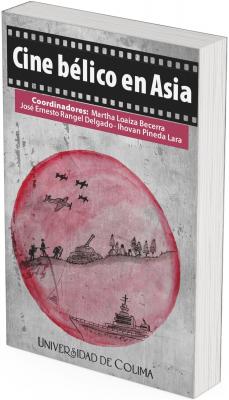
War Films in Asia
Keywords:
Research, study, cinema, film series, movie, historiofothy (historiofotía), society and culture, World War I, Russian revolution, Russian civil war, Asia PacificSynopsis
War Films in Asia contributes to the dissemination of knowledge about Cambodia, China, Indonesia, Japan, Korea, and Russia. Its important to narrow down that the selected film works were part of the billboard in the Society and Culture in Asia Film Series: A view from Contemporary Cinema, an annual event commentated by professor-researchers associated to the University Center for Study and Research on the Pacific Rim during last thirteen years.
Research, study, cinema, film series, movie, historiofothy (historiofotía), society and culture, World War I, Russian revolution, Russian civil war, Asia Pacific.
Downloads
References
Cine paraíso. (s.f.). Doctor Zhivago. Un film de David Lean. Recuperado de https://cineclasico4.webcindario.com/doctor.htm
Ferrari, A. (1988). Eugenio Montejo y el alfabeto del mundo. En Alfabeto del mundo. México: Fondo de Cultura Económica.
Filmaffinity México. (s.f.). Doctor Zhivago. Recuperado de https://www.filmaffinity.com/mx/film977246.html
Gainza, A. G. (1998). Semiótica y semántica: la comprensión del discurso. Revista Reflexiones, 73 (1): 3-14.
Garrón, P. (s.f.). Doctor Zhivago, cuando la RENFE se hizo soviética. Entrenvista. El ferrocarril en tus manos. Recuperado de https://www.trenvista.net/cultura/cinefilos-al-tren/doctor-zhivago-la-renfe-sovietica/
Gomez, J. (2009). La Revolución Rusa de 1917. Recuperado de: https://historiageneral.com/2009/03/13/la-revolucion-rusa-de-1917/
López, A. (1999) El símbolo de la casa en la poesía de Yorgos Seferis. Recuperado de Espéculo. Revista de estudios literarios, Universidad Complutense de Madrid. Recuperado de http://www.ucm.es/info/especulo/numero15/montejo.html
Portal de Historia de la Humanidad (2019). Primera Guerra Mundial. Recuperado de: https://profeenhistoria.com/primera-guerra-mundial/
Pérez, J. y Merino, M. (2010). Definición de semántica. Recuperado de https://definicion.de/semantica/
Significados.com. (s.f.). Significado de campo semántico. Recuperado de https://www.significados.com/campo-semantico/
Sinapsis. (2016). La Guerra Civil Rusa,1918-1921. Recuperado de https://puntosinapsis.wordpress.com/2016/12/20/la-guerra-civil-rusa-1918-1921/
S.N. (2016). Guerra Civil Rusa. Recuperado de: http://enciclopedia.us.es/index.php/Guerra_Civil_Rusa
Stam, R.; Burgoyne, R. y Flitterman-Lewis, S. (1999). Nuevos conceptos de la teoría del cine. Estructuralismo, semiótica, narratología, psicoanálisis, intertextualidad. España: Paidós.
Sorlin, P. (1985). Sociología del cine. La apertura para la historia de mañana. México: Fondo de Cultura Económica.
The Cinema Archives. (s.f.). The 33rd Best Director of All-Time: David Lean. Recuperado de http://thecinemaarchives.com/2019/05/13/the-33rd-best-director-of-all-time-david-lean/
The Telegraph. (2011). Eddie Fowlie. Recuperado de https://www.telegraph.co.uk/news/obituaries/culture-obituaries/film-obituaries/8341501/Eddie-Fowlie.html
Wikipedia (s.f.). Doctor Zhivago. Recuperado de https://es.wikipedia.org/wiki/Doctor_Zhivago
Bassols Batalla, Á. (1993). Geografía y subdesarrollo. México y el mundo. México: Editorial nuestro tiempo.
Castillo, J. (2019). El alma rusa. Santiago de Chile. Instituto de Estudios de la Sociedad, IES Chile. Recuperado de https://www.ieschile.cl/2019/06/el-alma-rusa/
Cine y trabajo (1 de junio de 2012). 'El camino de la vida', Nikolai Ekk, 1931. Recuperado de https://cineytrabajo.wordpress.com/2012/06/01/elcamino-de-la-vida-nikolai-ekk-1931/
Danylov, A. A. (2012). Historia de Rusia desde los tiempos antiguos hasta nuestros días. Preguntas y respuestas (en idioma ruso). Moscú, Rusia: Editorial, Prospekt.
Duran, J. (6 de noviembre de 2016). "Determinismo y Posibilismo" geográficos. Recuperado de http://profjoseduran.blogspot.com/2016/11/determinismo-y-posibilismo-geografico.html
EcuRed. (14 de diciembre de 2015). Ven y mira. Recuperado de https://www.ecured.cu/index.php?title=Ven_y_mira&oldid=3390259.
EFE. (2019). Más patriotismo en el cine, la receta de Rusia para combatir a Hollywood. Madrid, España. El Imparcial. Recuperado de https://www.elimparcial.es/noticia/197684/cultura/mas-patriotismo-en-elcine-la-receta-de-rusia-para-combatir-a-hollywood.html
Journal-club (2012). Pioner, Moscú, Rusia. Journal-club.ru. Recuperado de https://doi.org/10.1038/ki.2012.236
Kosti, Bgy. (13 de agosto de 2014). Masacre: Ven y mira (Idí I Smatrí). Recuperado de https://cachecine.blogspot.com/2014/08/clausura-csf-masacre-ven-y-mira-idi-i.html
Maguregui, C. (2004). Padre e hijo el amor total. Producciones no domesticadas. Recuperado de https://textodromo.wordpress.com/2004/04/26/padre-e-hijo-el-amor-total/
Maltseva, A. (2014). Cómo son los rusos... según las encuestas. Moscú, Rusia. Russia Beyond. Recuperado de https://es.rbth.com/sociedad/2014/01/29/como_son_los_rusossegun_las_encuestas_36781
Massanet, A. (2010). Andrei Tarkovsky: La Infancia de Ivan. España. Espinof. Recuperado de https://www.blogdecine.com/criticas/andrei-tarkovski-la-infancia-de-ivan
Mego, A. (mayo de 2010). No mires atrás. Los sótanos del cine. Recuperado de http://www.tetonadefellini.com/2010/05/idi-i-smotri-come-andsee-1985.html
News Front. (2020). «Cerraremos las bocas sucias»: Presidente Putin dice que Rusia combatirá la reescritura de la historia de la Segunda Guerra Mundial con un nuevo centro de archivos gratuito. Moscú, Rusia. News Front. Recuperado de https://es.news-front.info/2020/01/19/cerraremos-las-bocas-sucias-presidente-putin-dice-que-rusia-combatira-la-reescritura-de-la-historia-de-la-segunda-guerra-mundial-conun-nuevo-centro-de-archivos-gratuito/
Ottone, E. (2017). El alma rusa. Santiago, ideas, crítica, debate. Universidad Diego Portales. Santiago de Chile. Recuperado de http://revistasantiago.cl/pensamiento/el-alma-rusa/
Quelart, R. (2018). Las frases célebres de 'El Principito', sobre la esencia de la vida. La Vanguardia. Barcelona, España. S.L.U. Recuperado de https://www.lavanguardia.com/cultura/20180406/442201231936/frases-celebres-el-principito.html
Roig, X. (2019). L'Enigma Rus. Barcelona, España: Ediciones La Campana Saint-Exupéry, A. de (1943). El principito. Recuperado de http://bibliotecadigital.ilce.edu.mx
Stam, R., Burgoyne, R. y Fiiterman-Lewis, S. (1999). Nuevos conceptos de la teoría del Cine. Barcelona, España: Paidós
Subbotin, S. (2020). Historia del Cine Ruso. Moscú, Rusia. Rusopedia. Recuperado de https://rusopedia.rt.com/cultura/cine/issue_109.html
Vincent, M. (2017). Putin el domador del alma rusa. Madrid, España. El País. Recuperado de https://elpais.com/elpais/2017/08/13/actualidad/1502625252_716300.html
Wikipedia (2020). Organización de pioneros Vladimir Lenin. Recuperado de https://es.wikipedia.org/wiki/Organizaci%C3%B3n_de_Pioneros_Vlad%C3%ADmir_Lenin
Yegórov, O. (2015). El movimiento pionero soviético renace en Rusia. Moscú, Rusia. Russia Beyond. Recuperado de https://es.rbth.com/2015/11/16/el-movimiento-pionero-sovietico-renace-en-rusia_540805
Yegórov, O. (2017). ¿Por qué los rusos tienen ese aspecto tan melancólico? Moscú, Rusia. Russia Beyond. Recuperado de https://es.rbth.com/política-y-sociedad/sociedad/2017/05/01/por-que-los-rusos-tienenese-aspecto-tan-melancolico_753914
45-rpm.net. (2020). El movimiento infantil comunista de los pioneros. La Habana, Cuba. Recuperado de http://45-rpm.net/sitio-antiguo/palante/pioneros.htm
Baidu 百度. (25 de marzo de 2020). Riben guizi 日本鬼子. Recuperado en julio de 2020, de Baidu baike百度百科: https://baike.baidu.com/item/%E6%97%A5%E6%9C%AC%E9%AC%BC%E5%AD%90/3393
Berry, C. (2010). Now You See It, Now You Don't: Censorship in China. En R. Doraiswamy, & Padgaonkar, Asian Film Journey. Selections from Cinemaya (pp. 48-58). Delhi: Wisdom Tree y Netpac.
Cai, S. (2017). Contemporary Chinese Films and Celebrity Directors. Singapur: Palgrave MacMillan. https://doi.org/10.1007/978-981-10-2966-0
Chalmers, J. (1962). Peasant Nationalism and Communist Power. The Emergence of Revolutionary China, 1937-1945. Stanford: Stanford University Press.
Chan, J. K. (2019). Chinese Revolutionary Cinema. Propaganda, Aesthetics and Internationalism, 1949-1966. Londres: I.B. Taurus.
Chen, X. (1990). Shadowplay: Chinese Film Aesthetics and their Philosophical and Cultural Fundamentals. En G. S. Semsel, H. Xia, & J. Hou, Chinese Film Theory. A Guide to New Era. Nueva York: Praeger.
Cheung, D. (Junio de 2019). Resistance and Collaboration in Chinese World War II Films. Recuperado en Agosto de 2020, de World History Connected: https://worldhistoryconnected.press.uillinois.edu/16.2/forum_cheung.html
Deppman, H. C. (2010). Adapted for the Screen The Cultural Politics of Modern Chinese Fiction and Film. Honolulu: University of Hawai'i Press. https://doi.org/10.21313/hawaii/9780824833732.001.0001
Feng, Xiaogang, Li, G., Li, X., Zheng, X. (Escritores), & Feng, X. (Dirección). (1993). Un beijingés en Nueva York [Película]. China.
Giddins, G. (2006). Natural Selection: Gary Giddins on Comedy, Film, Music, and Books. Oxford: Oxford University Press.
Gray, G. (2010). Cinema. A Visual Anthropology. Oxford: Berg.
Haokan Baidu 好看 百度. (8 de Agosto de 2020). Zhongguo nuren daodi you duo qiang, riben guizi siling bu dou gan yige ren chuang 抗战:中国 女人到底有多强,日本鬼子司令部都敢一个人闯 Guerra Antijaponesa: Qué fuerte es una mujer china, el comando de los diablos japoneses se atreve a luchar solo. Recuperado el 10 de agosto de 2020, de 好 看 百度 Haokan Baidu: https://haokan.baidu.com/v?vid=9696445047319668982&pd=bjh&fr=bjhauthor&type=video
Haro, F. J. (Julio de 2019). Fugu y cinetización de las relaciones sociales en el cine de Ang Lee. Perspectivas, (8), 466-477. https://doi.org/10.35305/prcs.v0i8.73
Heng, L. (escritor) & Zhang, Y. (dirección). (2011). Flores de la guerra.
Jiang, W. (dirección). (2000). Guizi lai le 鬼子來了 Los demonios en mi puerta [Película]. China: Fortissimo Films.
Las flores de la guerra, Jinjling shisan chai 金陵十三钗 [Película]. China.
Lee, V. P. (2015). The Lightness of History Screening the Past in Hong Kong Cinema. En E. M. Cheung, G. Marchetti, & E. C. Yau, A Companion to Hong Kong Cinema (pp. 501-522). Malden, MA: John Wiley. https://doi.org/10.1002/9781118883594.ch26
Liu, W. (07 de Julio de 2007). Our Brando's moment in the Sun. Recuperado el 19 de marzo de 2019, de China Daily: http://www.chinadaily.com.cn/cndy/2007-07/17/content_5437306.htm
Matsui, M. & Matsui, M. (dirección). (2001). Devils: Confessions of Imperial Army Soldiers from Japan's War Against China Riben Guizi 日本鬼 子 [Película]. Japón.
Matsui, M., & Oguri, K. (s/f). Filmmakers Matsui Minoru and Oguri Ken'ichi Discuss 'Japanese Devils'. https://asiasociety.org/filmmakers-matsuiminoru-and-oguri-kenichi-discuss-japanese-devils. (C. Yoon, entrevistador) Asia Society.
McKenna, A., & Yu, T. K. (2016). Internationalising Memory. Traumatic Histories and the PRC's to Win an Oscar. En F. Chan, & Andy Willis, Chinese Cinemas. International Perspectives (pp. 21-36). Londres: Routledge. https://doi.org/10.4324/9781315691893-3
Nelson Schultz, C. K. (2016). Mediating Trauma. The Nanjing Massacre, City of Life and Death, and affect as soft power. En F. Chan, & A. Willis, Chinese Cinemas. International Perspectives (p. 54). Londres: Routledge. https://doi.org/10.4324/9781315691893-5
Qi, W. (2014). Memory, Subjectivity and Independent Chinese Cinema. Edinburgh: Edinburgh University Press.
Shi, Y. (27 de octubre de 2002). 姜文《鬼子来了》日本违规公映四方各有说法. Recuperado el 28 de octubre de 2002, de Sina 影音娱乐: http://ent.sina.com.cn/m/c/2002-06-27/89146.html
Star Wars. (10 de marzo de 2020). Databank. Recuperado el 21 de marzo de 2020, de Star Wars: https://www.starwars.com/databank/baze-malbus
Takeda, K. (2014). The interpreter as traitor: Multilingualism in Guizi lai le (Devils on the Doorstep). Linguistica Antverpiensia, New Series. Themes in Translation Studies, 13, 93-111. https://doi.org/10.52034/lanstts.v13i.71
Tsu, T. Y. (2015). A Genealogy of Anti-Japanese in Chinese War Films, 1949-2011. En K.-f. Tam, T. Y. Tsu, & S. Wilson, Chinese and Japanese Films on the Second World War (pp. 12-25). Londres: Routledge.
Tsu, T. Y., Wilson, S., & Tam, K.-f. (2015). The Second World War in postwar Chinese and Japanese Film. En K.-f. Tam, T. Y. Tsu, & S. Wilson, Chinese and Japanese Films on the Second World War. Londres: Routledge.
Von Haselberg, C. (2015). Devils on Doorstep. En G. Bettinson, Directory of World Cinema. China 2 (Vol. 26, pp. 128-130). Bristol, GB: Intellect.
Wen, J. (Escritor), Xia, Y., & Ning, J. (Dirección). (1994). En el calor del sol-Yangguang canlan de rizi-阳光灿烂的日子 [Película]. China.
Wikipedia Weijibaike 维基百科. (16 de abril de 2020). Riben guizi 日本鬼子. Recuperado el 17 de julio de 2020, de Wikipedia: https://zh.wikipedia.org/wiki/%E6%97%A5%E6%9C%AC%E9%AC%BC%E5%AD%90
Xiao, L. (2014). From the Glaring Sun to Flying Bullets: Aesthetics and Memory in the 'Post-' Era Chinese Cinema. En M. D. Johnson, K. B.
Wagner, T. Yu, & L. Vulpiani, China's iGeneration. Cinema and Moving Image Culture for the Twenty-first Century (pp. 321-336). Nueva York: Bloomsbury.
Xu, G. S. (2007). Sibascape. Contemporary Chinese Cinema. Lanham, Maryland: Rowman Littlefield Publishers.
Zhang, Y. (2004). Chinese National Cinema. New York: Routledge. https://doi.org/10.4324/9780203645833
Zhang, Y., & Xiao, Z. (1998). Encyclopedia of Chinese Film. Londres: Routledge.
Zhi Hu 知乎. (9 de Agosto de 2020). ¿Saben los japoneses que se les llama "diablos japoneses", "diablos" y "pequeño Japón"? Riben ren zhidao ziji bei cheng wei 'riben guezi''guizi''xiao riben'ma?日本人知道自己被称 为「日本鬼子」「鬼子」「小日本」吗?. Recuperado el 20 de agosto de 2020, de Zhi Hu: https://www.zhihu.com/question/271135885
A.P. (12 de enero de 1982). Jiro Horikoshi, 78, dies in Tokyo; designer of Zero fighter aircraft. The New York Times. https://www.nytimes.com/1982/01/12/obituaries/jiro-horikoshi-78-dies-in-tokyo-designer-of-zero-fighter-aircraft.html
Barshay, A., Boot, W., Craig, A., De Bary, B., Duus, P., Elisonas, J. y Wong, A. (2005). Sources of Japanese Tradition: Volume 2, 1600 to 2000. Bary W., Gluck C., & Tiedemann A. (Eds.). New York: Columbia University Press.
Cavallaro, D. (2015). Hayao Miyazaki's world picture. Jefferson: McFarland & Co.
Endo, H. (productor), Yamazaki, T. (director). (2013). Zero eterno. [cinta cinematográfica]. Japón: Toho Company.
Ferro, M. (2008). El cine, una visión de la historia. Madrid: Akal.
Gubern, R. (2014). Historia del cine. Barcelona: Anagrama.
Kotaki, S. (productor), Narashima, I. (director). (2011). Rengō kantai shirei chōkan: Yamamoto Isokoru [cinta cinematográfica]. Japón: Bandai Visual Company.
Lee, M. (12 de abril de 2014). Film Review: 'The Eternal Zero'. Variety. https://variety.com/2014/film/asia/film-review-japanese-hit-the-eternal-zero-1201155266/
Lenburg, J. (2012). Hayao Miyazaki. Japan's premier anime storyteller. Legends of animation. Nueva York: Chelsea House.
Maruyama, M. (1969). Thought and behaviour in Modern Japanese Politics. Londres: Oxford University Press.
Michitoshi T., Knauth L., y Tanaka M. (eds.) (1987). Política y pensamiento político en Japón, 1926-1982. México, D.F.: El Colegio de México. https://doi.org/10.2307/j.ctv26d9d0
NHK (productor), Arakawa, K. (director). (2019). 10 years with Hayao Miyazaki [serie documental de 4 episodios]. Japón: NHK World T.V. Disponible en https://www3.nhk.or.jp/nhkworld/en/ondemand/program/video/10yearshayaomiyazaki/?type=tvEpisode&
Nohara, S. y Dan, G. (1983). A6M Zero in action. Carrollton: Squadron/Signal Publications.
Okumiya, M., Jiro, H. y Martin, C. (2002). Zero! Nueva York: ibooks.
Pfeifer, M. (2011). War criminals and kamikaze pilots as role models. The past and the present in contemporary Japanese war movies. En Tito Genova, Valiente y Hiroko, Nagai (eds.) War memories, monuments and Media. Representations of conflicts and creation of histories of World War II (pp. 72-100). Manila: Ateneo de Manila University.
Richie, D. (2012). A hundred years of Japanese film. A concise history, with a selective guide to DVDs and Videos. Nueva York: Kodansha USA.
Schilling, M. (11 de mayo de 2014). Flights of fancy - box office smash The Eternal Zero reopens old wounds in Japan with its take on wartime kamikaze pilots. The Japan Times. Recuperado de: https://www.scmp.com/lifestyle/arts-culture/article/1508179/flights-fancy-boxoffice-smash-eternal-zero-reopens-old
Schilling, M. (20 de febrero de 2014). Debate still rages over Abe-endorsed WWII drama. The Japan Times. https://www.japantimes.co.jp/culture/2014/02/20/films/debate-still-rages-over-abe-endorsed-wwii-drama/#.U40-OyhdBGU
Standish, I. (2006). A new history of Japanese cinema. A century of narrative film. Nueva York: The continuum international publishing group. https://doi.org/10.5040/9781628929195
Stegewerns, D. (2015). Establishing the genre of the revisionist war film: The Shin-Toho body of post-Occupation war films in Japan. En King-fai Tam, Tomothy Y. Tsu y Sandra Wilson (eds.), Chinese and Japanese films on the Second World War (pp.93-106). Londres: Routledge.
Suzuki, T. (productor), Miyazaki, Hayao (director). (2013). El viento se levanta [cinta animada]. Japón: Studio Ghibli.
Thomas, J. (productor), Oshima, N. (director). (1983). ¡Feliz navidad, Sr. Lawrence!. [cinta cinematográfica]. Francia: National Film Trustee Company.
Van der Post, L. (2002). The seed and the sower. Londres: Random House.
Wesleyan (30 de agosto, 2010). Bruce McKenna on writing and producing "The Pacific" [video] Youtube. Disponible en https://www.youtube.com/watch?v=vf7a5N1-UDk
Yoshida, S. (1961). The Yoshida Memoirs, Londres: Heinemann.
Bourke, J. (2001). The Second World War A People's History. Londres: Oxford Universtity Press.
Burch, N. (1979). To the distant observer. Form and meaning in the Japanese cinema. Revisado y editado por Annette Michelson. Estados Unidos: University of California Press/Berkeley y Los Angeles.
Cavallaro, D. (2010). Anime and the Art of Adaptation Eight Famous Works from Page to Screen. Carolina del Norte, Estados Unidos: McFarland & Company, Inc., Publishers.
Clements, J. y McCarthy, H. (2006). The Anime Encyclopedia, Revised and Expanded Edition, Berkeley, CA: Stonebridge Press.
Cockerill, H. (2007). Laughter and Tears: The Complex Narratives of Showa Gesaku Writer Nosaka Akiyuki. Japanese Studies, 27(3), 295-303. Disponible en https://doi.org/10.1080/10371390701685088
Dower, J. W. (1999). Embracing defeat. Japan in the wake of World War II. Nueva York: Norton & Co.
Declaración de Hirohito (1945). Emperor Hirohito, Accepting the Potsdam Declaration, Radio Broadcast. Transmitted by Domei and Recorded by the Federal Communications Commission, 14 August 1945. Disponible en https://www.mtholyoke.edu/acad/intrel/hirohito.htm
Entrevista a Takahata por Littardi, Cedric (1993). An Interview with Isao Takahata para AnimeLand (a French anime fanzine), No. 6 (julio - agosto, 1992) pp. 27-29, traducción del francés al inglés de Ken Elescor (octubre de 1993). Disponible en http://www.nausicaa.net/miyazaki/interviews/t_corbeil.html
Goldberg, W. (2009). Transcending the victim's history: Takahara Isao's Grave of the Fireflies. Mechademia 4, 39-52. https://doi.org/10.1353/mec.0.0030
Independent (2016). Akiyuki Nosaka: Author who recalled the fire-bombing of Japanese cities in his best-known work, Grave of the Fireflies.En Obituaries del Independent. Disponible en: https://www.independent.co.uk/news/obituaries/akiyuki-nosaka-author-who-recalled-the-fire-bombing-of-japanese-cities-in-his-best-known-work-grave-a6868616.html
Japan Times (2013). Casting a little light on fireflies. Disponible en https://www.japantimes.co.jp/news/2013/04/14/national/science-health/casting-a-little-light-on-fireflies/
LaCAPRA, D. (2005). Escribir la historia, escribir el trauma. Buenos Aires: Nueva Visión.
Lamarre, T. (2009). The Anime Machine A Media Theory of Animation. Minneapolis: University of Minnesota Press.
Minamida, M. (2000). Kindai animeshigairon, en Nijuseikianimetaizen. Tokio: Futabasha citado por Naiper, Susan J. (2000).
Miyao, D. (2002). Before anime: animation and the Pure Film Movement in pre-war Japan. Japan Forum, 14(2), 191-209. Disponible en https://doi.org/10.1080/09555800220136356
Naiper, S. J. (2000). Anime from akeira to Prencess Mononoke. Experiencing contemporary Japanese animation. Nueva York: Palgrave Macmillan.
Rosenbaum, R. (2011). Legacies of the Asia-Pacific War The yakeato (the burnt-out ruins) generation. En Rosenbaum, Roman y Claremont, Yasuko (eds.) Legacies of the Asia-Pacific War. The yakeato generation (pp.3-23). Nueva York: Routledge. Disponible en https://www.academia.edu/37021274/Introduction_Legacies_of_the_Asia_Pacific_War_The_Yakeato_the_burnt_out_ruins_Generation
Rosenbaum, R. y Claremont, Y. (2007). Yakeato: An Introduction. Japanese Studies, 27(3), 279-280. https://doi.org/10.1080/10371390701685054
Sato, T. (1982). Currents in Japanese cinema: essays. Tokio: Kodansha International.
Semblanza-Cool Japan (2015). Akiyuki Nosaka, semblanza y último adiós. Disponible en https://cooljapan.es/akiyuki-nosaka-semblanza-y-ultimo-adios/
Stahl, D. C. (2010). Victimization and "response-ability": remembering, representing, and working through trauma in Grave of the Fireflies. En Stahl, David y Williams, Mark (Eds.) Imag(in)ing the War in Japan Representing and Responding to Trauma in Postwar Literature and Film (pp.161-202). Liden/Boston: Brill. https://doi.org/10.1163/ej.9789004182981.i-362.46
Suzuki, W. (2017). Sacred or Profane? Representing War Orphans in the Postwar Occupation of Japan: Ishikawa Jun's "The Jesus of the Ruins". Japan Studies Association Journal, 15(1), 127-144.
Swale, A. (2017). Memory and forgetting: examining the treatment of traumatic historical memory in Grave of the Fireflies and The Wind Rises, Japan Forum. Disponible en: https://doi.org/10.1080/09555803.2017.1321570
The Walters Art Museum (2020). Print number 14 in Hironobu's series "Dogi Taikoki. Disponible en https://art.thewalters.org/detail/38703/dogitaikoki/
Yomota, I. (2014). What is Japanese cinema? a history. Nueva York: Columbia University Press.
Fernández, C. R. y Borque, E. (2013). El conflicto de Corea. Madrid, España: Instituto de Estudios Internacionales y Europeos "Francisco de Vitoria", Universidad Carlos III de Madrid.
Fontana, J. (2017). El siglo de la revolución. Una historia del mundo desde 1914. Barcelona, España: Critica.
Helgeson, C. (2019). South Korean film delivers nuanced portrait of war. The Johns Hopkins News-Letter. Consultado 22 de abril de 2020. Disponible en https://www.jhunewsletter.com/article/2019/05/south-korean-film-delivers-nuanced-portrait-of-war
Holcombe, C. (2016). Una historia de Asia Oriental. De los orígenes de la civilización al siglo XXI. México: Fondo de Cultura Económica.
Kang Je-kyu. (s.f.). People Pill. Consultado el 20 de octubre de 2019. Disponible en https://peoplepill.com/people/kang-je-gyu/.
Kang, Je-kyu. (2011). I Devoted My Passion to 'My Way'. News KBS. Consultado el 22 de octubre de 2019. Disponible en https://web.archive.org/web/20140407083157/http://english.kbs.co.kr/news/entertainment_news_view.html?No=8016
Kang, Je-kyu. (2015). Korean Film Biz Zone. Consultado el 18 de octubre de 2019. Disponible en https://www.koreanfilm.or.kr/eng/films/index/peopleView.jsp?peopleCd=10000854.
Kim, J. (2010). A tale of two brothers 'Taegukgi'. The Korea Herald. Consultado el 19 de febrero de 2020. Disponible en http://www.koreaherald.com/view.php?ud=20050113000040.
Lee, J. (2006). Film review: Tae Guk Gi: The Brotherhood of war (Taegukgi Hwinalrimyeo). News and Reviews. Consultado el 15 de marzo de 2020. Disponible en http://thekeep.eiu.edu/history_fac/55.
Lee, Nikki J. Y. y Stringer, J. (2010). Korean Blockbusters: yesterday, today and tomorrow. En Daniel Martin y Mark Morris (Eds.) Discovering Korean Cinema (pp. 57-69). London, United Kingdom: The Korean Cultural Centre UK.
Limb, Jae-un. (2015). Korean film via stamps-TaeGukGi: Brotherhood of War. Korea net, News Focus, Culture. Consultado el 17 febrero de 2020. Disponible en http://www.korea.net/NewsFocus/Culture/view?articleId=125826.
López, J.F., Romero, A., Escalona, A. y León, J. L. (2009). El rompecabezas coreano de la Posguerra: legado colonial, liberación, división y guerra (1945-1953). En José Luis León Manríquez (coord.) Historia mínima de Corea (pp.117-146). México: El Colegio de México.
Pike, F. (2011). Empires at War. A short history of modern Asia since World War II. New York, United States: I. B. Tauris. Películas https://doi.org/10.5040/9780755619610
Kang, Je-kyu. (2004). La hermandad de la guerra (Tae guk-gi-The Brotherhood of war). Kang Je-kyu Films.
Bienvenido, L. (2002). La divulgación científica a través del género documental. Mediatica, 69-84. Obtenido de http://repositori.uji.es/xmlui/bitstream/handle/10234/183015/Leon%2cDivulgacio%cc%81nCientDocumental.pdf?sequence=1&isAllowed=y
Burke, P. (2005). Visto y no visto. El uso de la imagen como documento histórico. (T. d. Lozoya, Trad.) España: Cultura Libre.
Campo, J. (2015). Cine documental: tratamiento creativo (y político) de la realidad. Cine Documental, 1-28. Obtenido de https://ri.conicet.gov.ar/bitstream/handle/11336/46146/CONICET.pdf?sequence=5&isAllowed=y
Castillo, G. (2007). Comentarios al humanismo. Revista de Comunicación (6), 89-98.
Chandler, D., Roff, W., y Small, J. R. (1987). In Search of Southeast Asia: A Modern History. (D. J. Steinberg, Ed.) Honolulu: University of Hawaii Press.
Libros envenenados. (enero de 2018). Obtenido de http://librosenvenenados.blogspot.com/2018/01/el-ano-que-vivimos-peligrosamente-year.html
Lloga, S. C. (2020). Los modos del cine documental. Análisis de tres modelos. AISTHESIS (67). Obtenido de https://doi.org/10.7764/67.4
López, V. y Lacruz, C. (2007). El teatro de sombras en la Educación Física. researchgate.net, 113-119. Obtenido de Tandem: https://www.researchgate.net/profile/Inma_Canales-Lacruz/publication/297717333_El_teatro_de_sombras_en_la_educacion_fisica/links/56e1629c08aec09a8bbec4ba/El-teatro-de-sombras-en-la-educacion-fisica.pdf
Márquez, R. (30 de junio de 2014). ZoomF.7. Recuperado el diciembre de 2020, de https://zoomf7.net/2014/06/30/por-que-el-cine-es-un-arte/MUBI. (s.f.). MUBI. Obtenido de https://mubi.com/es
Nichols, B. (2013). Introducción al documental. Ciudad Universitaria, Coyoacán: UNAM.
Rosenstone, R. (2005). La historia en imágenes, la historia en palabras: reflexiones sobre la posibilidad real de llevar la historia a la pantalla. Revista Istor (20), 91-108. Obtenido de http://www.istor.cide.edu/archivos/num_20/dossier5.pdf
Rotha, P. (2010). Algunos principios del documental. Revista Cine Documental, 2, 1-16. Obtenido de http://revista.cinedocumental.com.ar/wp-content/uploads/rotha_algunos%20principios_n2.pdf
Sorlin, P. (2005). El cine, reto para el historiador. Revista Istor, No. 20, 11-35.
Wir, P. (Dirección). (1982). The Year of Living Dangerously [Película].
Fichas técnicas de las películas Camboya
Título original: The Killing Fields (Los gritos del silencio)
Dirección: Roland Joffé
Producción: Iain Smith y David Puttnam
Intérpretes: Sam Waterston, Haing S. Ngor, John Malkovich, Julian Sands, Craig T. Nelson, Spalding Gray, Bill Paterson, Patrick Malahide y Athol Fugard
Guion: Bruce Robinson
País y año: Camboya, 1984
Título original: First They Killed my Father (Primero mataron a mi padre)
Dirección: Angelina Jolie
Producción: Angelina Jolie, Rithy Panh y Ted Sarandos
Intérpretes: Sreymoch Sareum, Kompheak Phoeung, Socheta Sveng y Sreyneang Oun
Guion: Angelina Jolie, Loung Ung y Steven Knight
País y año: Camboya, 2017
Título original: The Missing Picture (La imagen perdida)
Dirección: Rithy Panh
Producción: Catherine Dussart
Intérpretes: Jean-Baptiste Phou y Randal Douc
Guion: Rithy Panh y Christophe Bataille
País y año: Camboya, 2013
Indonesia
Título original: The Year of Living Dangerously (El año en que vivimos en peligro)
Dirección: Peter Weir
Producción: James McElroy, Joe Constantino, Mark Egerton, Murray Francis, Tim Sanders y John Hollands
Intérpretes: Mel Gibson, Sigourney Weaver y Linda Hunt
Guion: C. J. Koch y Peter Weir
País y año: Indonesia, 1982
Título original: The Act of Killing (El acto de matar)
Dirección: Joshua Oppenheimer
Producción: Signe Byrge Sørensen, Werner Herzog, Errol Morris, Andre Singer y Joram Ten Brink
Intérpretes: Anwar Congo, Herman Koto y Syamsul Arifin
Guion: Joshua Oppenheimer
País y año: Indonesia, 2012
Título original: The Look of Silence (La mirada del silencio)
Dirección: Joshua Oppenheimer
Producción: Signe Byrge Sørensen y Werner Herzog
Intérpretes: Adi Rukun, M.Y. Basrun y Amir Hasan
Guion: Joshua Oppenheimer
País y año: Indonesia, 2014
Downloads
Published
Series
Categories
License

This work is licensed under a Creative Commons Attribution-NonCommercial-ShareAlike 4.0 International License.