
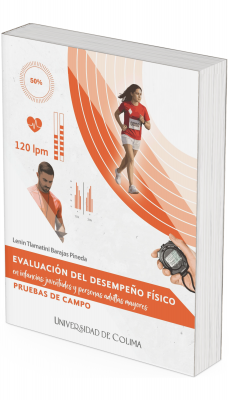
Evaluación del desempeño físico en infancias, juventudes y personas adultas mayores. : Pruebas de campo
Palabras clave:
Desempeño físico, pruebas de campo, ciclo de vida, saludSinopsis
Evaluación del desempeño físico en infancias, juventudes y personas adultas mayores. Pruebas de campo, es una herramienta esencial para docentes, personas entrenadoras y profesionales del deporte interesados en evaluar la condición física a lo largo de todo el ciclo vital. Basado en evidencia científica y más de una década de experiencia, este compendio presenta pruebas de campo confiables, objetivas y accesibles, acompañadas de protocolos detallados y referencias internacionales. Su estructura didáctica facilita la aplicación en contextos educativos, deportivos y de salud, promoviendo evaluaciones seguras, precisas y orientadas al bienestar integral y al desarrollo de una cultura del movimiento.
Descargas
Referencias
Ab Rahman, Z., Kamal, A., Mohd Noor, M., Geok, S. y Alnedral. (2021). Reliability, validity and norm reference of standing broad jump. Geintec, Gestão, Inovação e Tecnologias, 11(3), 1340-1354. https://doi.org/10.47059/revistageintec.v11i3.2014
Adam, C., Klissouras, V., Ravazzolo, M., Renson, R., y Tuxworth, W. (1988). Eurofit: European test of physical fitness. Council of Europe, Committee for the Development of Sport.
Alonso, S. y Moreira, A. (2013). Valoración de la condición física en la educación infantil. Trabajo de investigación [inédito]. Facultad de Ciencias de la Educación y el Deporte. Universidad de Vigo. En Ayá, C. (2017). La valoración de la condición física en la educación infantil: principales test de aplicación (pp.108-109). Paidotribo.
Arnheim, D. D. y Sinclair, W. A. (1975). The clumsy child: A pro- gram of motor therapy. CV Mosby.
Ayala, F., Sainz de Baranda, P., de Ste Croix, M. y Santoja, F. (2012). Fiabilidad y validez de las pruebas sit-and-reach: revisión sistemática. Revista Andaluza de Medicina del Deporte, 5(2), 53-62. https://doi.org/10.1016/S1888-7546(12)70010-2
Ayán, C., Besada, A., Cancela, J. y Martínez, L. (2015). ¿Existe relación entre la resistencia aeróbica y el rendimiento académico en niños/as que cursan el segundo ciclo de la educación infantil? Resultados de un estudio piloto. Journal of Sport and Health Reserch, 7(1), 11-18.
Ayán, P. (2017). La valoración de la condición física infantil en la educación infantil: principales test de aplicación. Paidotribo.
Aziz, A. R., Chia, M. Y. y Teh K. C. (2005). Measured maximal oxygen uptake in a multi-stage shuttle test and treadmill-run test in trained athletes. J Sports Med Phys Fitness, 45, 306-14.
Bala, G., Popović, B. y Sabo, E. (2006). Influence of the kindergarten period on the development of children's psychosomatic characteristics. Kinesiologia slovenica, 12(1), 14-25.
Balke, B. (1963). A simple field for the assessment of physical fitness. Civil aeromedical research institute Report. Federal Aviation Agency.
Baumgartner, T., Jackson, A., Mahar, M. y Rowe, D. (2007). Measurement for evaluation in physical education and exercise science. McGraw Hill
Baumgartner, T., Jackson, A., Mahar, M. y Rowe, D. (2007). Measurement for evaluation in physical education and exercise science. McGraw Hill.
Bayer, O., von Kries, R., Straus, A., Mitschek, C., Toschke, A., Hose, A. y Koletzko, B. (2009). Short-and mid-term effects of setting-based prevention program to reduce obesity risk factors in children: A cluster-randomized trial. Clinical Nutrition, 28(2), 122-128. https://doi.org/10.1016/j.clnu.2009.01.001
Beekhuizen, K., Davis, M., Kloble, M. y Cheng, M. (2009). Test-retest reliability and minimal detectable change of the Hexagon Agility test. J Strength Cond Res, 23(7), 2167-71. https://doi.org/10.1519/JSC.0b013e3181b439f0
Bolonchuk, R. H. (1978). The accuracy of the six minutes run test to measure cardiorespiratory fitness. University of North Dakota.
Bos, K., Bappert, S., Tittlbach, S. y Woll, A. (2004). Karlsruher motorik-screening fur kindergartenkinder (KMS 3-6). Sportunterricht, 53(3), 79-87.
Bos, K., Bappert, S., Tittlbach, S. y Woll, A. (2004). Karlsruher motorik-screening fur kindergartenkinder (KMS 3-6). Sportunterricht, 53(3), 79-87.
Brantner, S., Piek, J. P. y Smith, L. M. (2009). Evaluation of the validity of the MAND in assessing motor impairment in young children. Rehabilitation Psychology, 54(4), 413. https://doi.org/10.1037/a0017315
Bravo, B., Ortega, C. y Villanueva, B. (1988). Evaluación del rendimiento físico (3ª ed.). México.
Brown, L. y Weir, J. (2001). Recomendación de procedimientos de la ASEP (Sociedad Americana de Fisiólogos del Ejercicio): Evaluación exacta de la fuerza y la potencia muscular. PubliCE, 1-20.
Bueno, M., Ruiz, L., Graupera, J. y Sánchez, F. (2000). Análisis comparativo de diferentes procedimientos de detección de los problemas evolutivos de coordinación motriz en los escolares de 4 a 6 años. CIDE-Ministerio de Educación y Cultura.
Ceballos-Gurrola, O., Bernal-Reyes, F., Jardón-Rosas, M., Enríquez-Reyna, M., Durazo-Quiroz, J. y Ramírez-Siqueiros. (2021). Composición corporal y rendimiento físico de jugadores de futbol soccer universitario por posición de juego. Retos, 39, 52-57. https://doi.org/10.47197/retos.v0i39.75075
Chow, S. M. K. y Henderson, S. E. (2003). Interrater and test-retest reliability of the movement assessment battery for Chinese preschool children. The American Journal of Occupational Therapy, 57(5), 574-577. https://doi.org/10.5014/ajot.57.5.574
Chow, S. M. K., Henderson, S. E. y Barnett, A. L. (2001). The movement assessment battery for children: A comparison of 4-year- old to 6-year-old children from Hong Kong and the United States. The American Journal of Occupational Therapy, 55(1), 55-61. https://doi.org/10.5014/ajot.55.1.55
CIMOHU (s.f.). Batería de Pruebas "Senior Fitness Test", Procedimiento y hoja de anotación y Evaluación. Universidad de Costa Rica, UC Davis University of California, Universidad de Sonora, Universidad de Baja California, Universidad de Colima, Universidad Veracruzana y Universidad Juárez del Estado de Durango.
Clemons, J., Campbell, B. y Jeansonne, Ch. (2010). Validity and reliability of a new test of upper body power. Journal of Strength and Conditioning Research, 24(6), 1559-1565. https://doi.org/10.1519/JSC.0b013e3181dad222
Conley, M. (2002). Effect of Adapted Physical Education Programs on Student Performance of Basic Motor Ability Skills in Elementary School [Tesis de doctorado, The University of Tennessee].
Cools, W., De Martelaer, K., Vandaele, B., Samaey, C. y Andries, C. (2010). Assessment of movement skill performance in preschool children: Convergent validity between MOT 4-6 and M-ABC. Journal of Sports Science and Medicine, 9(4), 597-604.
Cooper Institute for Aerobics Research. (2004). The Prudential Fitnessgram: Test administration manual (3ra ed.). Human Kinetics.
Cooper K. (1968). A means of assessing maximal oxygen intake. JAMA, 203 (3), 135-138. https://doi.org/10.1001/jama.1968.03140030033008
Cureton, T. (1951). Physical fitness of champions. University of Illinois Press.
Davis, B. (2000). Physical education and the study of sport (4ta ed.). Mosby.
Davis, K. L., Kang, M., Boswell, B. B., DuBose, K. D., Altman, S. R. y Binkley, H. M. (2008). Validity and reliability of the medicine ball throw for kindergarten children. The Journal of Strength and Conditioning Research, 22(6), 1958-1963. https://doi.org/10.1519/JSC.0b013e3181821b20
De Salles, M., Amaral, V., de Salles C. F., Tavares, F. y Martin, D. (2012). Validity and reproducibility of the Sargent Jump Test in the Assessment of Explosive Strength in Soccer Players. Journal of Human Kinetics, 33, 115-121. https://doi.org/10.2478/v10078-012-0050-4
Dolgener, F., Hensley, L., March, J. y Fjelstul, J. (1994). Validation of the Rockport Fitness Walking Test in College Males and Females. Research Quarterly for Exercise and Sport, 66(2), 152-158. https://doi.org/10.1080/02701367.1994.10607610
Draper, J. A. y Lancaster, M. G. (1985). The 505 test: A test for agility in the horizontal plane. Australian Journal for Science and Medicine in Sport, 17(1), 15-18.
Ellinoudis, T., Evaggelinou, C., Kourtessis, T., Konstantinidou, Z., Venetsanou, F. y Kambas, A. (2011). Reliability and validity of age band 1 of the movement assessment battery for children. Research in Developmental Disabilities, 32(3),1046-1051. https://doi.org/10.1016/j.ridd.2011.01.035
Fjortoft, I. (2000). Motor fitness in pre-primary school children: The EUROFIT motor fitness test explored on 5-7-year-old children. Pediatric Exercise Science, 12(4), 424-436. https://doi.org/10.1123/pes.12.4.424
Fjortoft, I., Pedersen, A. V., Sigmundsson, H. y Vereijken, B. (2011). Measuring physical fitness in children who are 5 to 12 years old with a test battery that is functional and easy to administer. Physical Therapy, 91(7), 1087-1095. https://doi.org/10.2522/ptj.20090350
Gabbet, T. y Sheppard, J. (2013). Testing and training Agility. Australian Institute of Sports, 12, 199-205.
García, G. y Secchi, J. (2014). Test course navette de 20 metros con etapas de un minuto. Una idea original que perdura hace 30 años. Apunts Med Esport, 49(183), 93-103. https://doi.org/10.1016/j.apunts.2014.06.001
González de los Reyes, Y. (2008). Validez, fiabilidad y especificidad de las pruebas de agilidad. U.D.C.A. Actualidad y Divulgación Científica, 11(2), 31-39. https://doi.org/10.31910/rudca.v11.n2.2008.621
Guralnik, J. M., Simonsick, E. M., Ferrucci, L., Glynn, R. J., Berkman, L. F., Blazer, D. G., Scherr, A. y Wallace, R. B. (1994). A Short Physical Performance Battery Assessing Lower Extremity Function: Association With Self-Reported Disability and Prediction of Mortality and Nursing Home Admission. Journal of Gerontology, 49(2), M85-M94. https://doi.org/10.1093/geronj/49.2.M85
Gómez, J.F., Curcio, C. L., Alvarado, B., Zunzunegui, M. V. y Guralnik, J. (2013). Validity and Reliability of the Short Physical Performance Battery (SPPB): a Pilot Study on Mobility in the Colombian Andes. Colomb Med, 44 (3), 165-71. https://doi.org/10.25100/cm.v44i3.1181
Haag, H., y Dassel, H. (1995). Test de condición física en el ámbito escolar y la iniciación deportiva. Hispano-Europea.
Henderson, S. E. y Sugden, D.A. (1992). Movement assessment battery for children manual. The Psychological Corporation Ltd.
Henderson, S. E., Sugden, D. A. y Barnett, A. L. (2007). Movement assessment battery for children-2 (2a ed.). The Psychological Corporation. https://doi.org/10.1037/t55281-000
Hernández, N., Álvarez, G., Bravo, F., Vieira, J., Reina, E. y Herrera, J. (2018). Validación de la prueba de Romberg Modificada para la determinación del tiempo de propiocepción inconsciente en adultos sanos. Revista Colombiana de Ortopedia y Traumatología, 32(2), 93-99. https://doi.org/10.1016/j.rccot.2017.11.001
Hetzler, R., Vogelpohl, R., Stickley, C., Kuramoto, A., DeLaura, M. y Kimura, I. (2010). Development of a modified Margaria-Kalamen anaerobic power test for American football athletes. J Strength Cond Res, 24(4), 978-984. https://doi.org/10.1519/JSC.0b013e3181b2ba42
Heyward, V. (2006). Evaluación y prescripción del ejercicio (2a ed.). Paidotribo.
Hong, H., Yang, H., Kim, D., Gonzalez, T., Brage, S. y Jeon, J. (2019). Validation of submaximal step test and the 6-min walk test for predicting maximal oxygen consumption in young and healthy participants. Int. J. Environ. Res. Public Heath, 16(23), 4858. https://doi.org/10.3390/ijerph16234858
Huesca, R. (2004). Índice de flexibilidad general. Rev Hosp Jua Mex, 71(2), 65-69.
Hui, S. y Yuen, P. (1998). Comparing the validity and reliability of the modified back saver sit-and reach test and four other protocols. Medicine and Science in Sports and Exercise, 30(5), 320. https://doi.org/10.1097/00005768-199805001-01816
Hunsicker, P. A., y Reiff, G. G. (1976). AAPHER youth fitness test manual. AAHPER Publications-Sales.
Hunsicker, P. A y Reiff, G. G. (1976). AAHPER, American Alliance for Health, Physical Education and Recreation. Youth Fitness Test Manual. AAHPER Publications.
Ikeda, T. y Aoyagi, O. (2008). Relationships between test characteristics and movement patterns, physical fitness, and measurement characteristics: Suggestions for developing new test items for 2-to 6-year-old children. Human Performance Measurement, 5, 9-22.
Instituto Nacional de Geriatría. (2019). Batería Corta de Desempeño Físico. Secretaria de Salud.
Instituto Nacional de Geriatría. (2022). Guía de instrumentos de evaluación de la capacidad funcional. Secretaria de Salud.
Jackson, A., Morrow, J., Jensen, R. Jones, N. y Schultes, S. (1996). Reliability of the Prudential FITNESSGRAM Trunk Lift Test in Young Adults. Research Quarterly for Exercise and Sport, 67(1), 115-117. https://doi.org/10.1080/02701367.1996.10607934
Jiménez, A. y De Paz, J. (2008). Application of the 1RM estimation formulas from the RM in bench press in a group of physically active middle-aged women. Journal of Human Sport and Exercise, 3(1), 10-22. https://doi.org/10.4100/jhse.2008.31.02
Kalamen, J. (1968). Measurement of maximum muscular power in man. [Tesis de grado]. The Ohio State University.
Kaneko y Fuchimoto (1993). Endurance performance capacity of 7 to 19 year boys and girls assessed by the shuttle stamina test (SST). En Claessens, A., Lefevre, J. y Van den Eyden, B. (Eds). World-Wide Variation In Physical Fitness (pp. 80-86). Institute of Physical Education, Catholic University of Leuven.
Klein, D., Koch, B., Dordel, S., Strüder, H. y Graf, C. (2012). The KiMo test: a motor screening for pre.schoool children aged 3-6 years. European Journal of Pediatric Neurology, 8(3), 135-143.
Kline, G., Porcari, J., Hintermeister, R., Freedson, P., Ward, A., Mccarron, R., Ross, J. y Ripe, J. (1987). Estimation of VO2máx from a one-mile track walk, gender, age and body weight. Medicine and Science in Sport and Exercise, 19 (3), 253-259. https://doi.org/10.1249/00005768-198706000-00012
Kraus, H. y Eisenmenger-Weber. S. (1945). Evaluation of posture based on structural and functional measurements. Phys Ther Rev, 25, 267-71. https://doi.org/10.1093/ptj/25.6.267
Kurimoto, E., Asami, T., Shibukawa, R., Matsuura, Y. y Katsube, A. (1981). [The final version of the field test of motor coordination by Research Center in Physical Education; The report of Committee of Motor Coordination]. Report of Research Center in Physical Education, 9, 207-212.
Langley, J. y Chetlin, R. (2017). Test Re-Test Reliability of Four Version of the 3-Cone Test in Non-Athletic Men. Journal of Sports Science and Medicine, 16,44-52.
Larkin, D. y Revie, G. (Ed.). (1994). Stay in step: A gross motor screening test for children K-2. University of New South Wales.
Léger, L.A., Mercier, D., Gadoury, C. y Lambert, J. (1988). The multistage 20-meter shuttle run test for aerobic fitness. J Sports Sci, 6, 93-101. https://doi.org/10.1080/02640418808729800
Liu, N.Y., Plowman, S.A. y Looney, M.A. (1992). The reliability and validity of the 20-meter shuttle test in American students 12 to 15 years old. Res Q Exerc Sport, 63, 360-5. https://doi.org/10.1080/02701367.1992.10608757
Lopategui, C. (2012). Prueba aeróbica (caminar-correr) de Cooper de 12 minutos. Saludmed.
Lopategui, C. (2012). Prueba aeróbica de caminar de una milla (Rockport). En Macau Sport Development Board of Macau SAR Government. (2003). Analysis on physical fitness of macao young children in 2002. www.sport.gov.mo/pt/macaosport/type/show/id/581
Lopategui, E. (2014). HPER-4308: Diseño de Programas de Ejercicio. Saludmed.com. Ciencias del Movimiento Humano y de la Salud. http://www.saludmed.com/ejercicio/ejercicio.html
Macau Sport Development Board of Macau SAR Government. (2003). Analysis on physical fitness of macao young children in 2002. www.sport.gov.mo/pt/macaosport/type/show/id/581
Mahoney, C. (1992). 20-MST and PWC170 validity in non-Caucasian children in the UK. Br J Sports Med, 26, 45-7. https://doi.org/10.1136/bjsm.26.1.45
Mann, B., Ivey, P., Mayhew, J., Schumacher, R. y Brechue, W. (2016). Relationship between agility test and short sprints: Reliability and smallest worthwhile difference in national collegiate athletic association division - I football players. Journal of Strength and Conditioning Research, 30(4), 839-900. https://doi.org/10.1519/JSC.0000000000001329
Margaria, R., Aghemo, P. y Rovelli, E. (1966). Measurement of muscular power (anaerobic) in man. Appl. Physiol, 21(5), 1662-1664. https://doi.org/10.1152/jappl.1966.21.5.1662
Markovic, G., Dizdar, D., Jukic, I. y Cardinale, M. (2004). Reliability and factorial validity of squat and countermovement jump test. Journal of strength and conditioning research, 18(3), 551-555. https://doi.org/10.1519/00124278-200408000-00028
Martínez, L. (2002). Pruebas de aptitud física. Paidotribo.
Marín-Jiménez, N., Pérez-Bey, A., Cruz-León., C., Conde-Caveda, J., Segura-Jiménez, V., Castro-Piñero, J. y Cuenca-García, M. (2024). Criterion-related validity and reliability of the standing long jump test in adults: The Adult-Fit project. Eur J Sport Sci, 24(9), 1379-1392. https://doi.org/10.1002/ejsc.12182
Maríns, J. (2003). Comparación de la frecuencia cardiaca máxima y fórmulas para su predicción. [Tesis de doctorado en ciencias de la actividad física. INEF. Universidad de Granda]. En Maríns, J. y Delgado, F. (2007). Empleo de ecuaciones para predecir la frecuencia cardiaca máxima en carrera para jóvenes deportistas. Archivo de medicina del deporte, 24(18), 112-120.
Matsudo, V. (1979). Avalição da potência anaeróbica: teste de corrida de 40 segundos. Rev de Ciências do Esporte, 1(1), 8-16.
Matsudo, V. (1988). Teste de corrida de 40 segundos: Perspectivas de uma década. Revista Brasileira de Ciencia e Movimiento, 2(2), 24-31.
Mayhew, J., Ball, T., Arnold, M. y Bowen, J. (1992). Relative muscular endurance performance as a predictor of bench press strength in college men and women. Journal of Applied Sport Science Research, 6(4), 200-206. https://doi.org/10.1519/00124278-199211000-00002
Mayhew, J., Ware, J., Bembe, M., Wilt, B., Ward, T., Bill, F., Juraszek, J. y Slovak, J. (1999). The NFL-225 Test as a measure of bench press strength in college football players. Journal of Strength and Conditioning Research, 13(2), 130-134. https://doi.org/10.1519/00124278-199905000-00006
Meredith, M. y Welk, G. (2010). Fitnessgram/Activitygram. Test Administration Manual. (4a ed.). The Cooper Institute
Miller, T. (2016). Guía de pruebas de evaluaciones de la NSCA. Paidotribo.
Miñarro, P., Andújar, P., García, P. y Toro, E. (2007). A comparison of the spine posture among several sit- and-reach test protocols. Journal of Science and Medicine in Sport, 10(6), 456-462. https://doi.org/10.1016/j.jsams.2006.10.003
Mondenard, J. (1987). Test des flexions de Ruffier-Dickson. Ann. Kiínesihér, 14(7-8), 381-388.
Montoye, H. J., Willis, P. W., Cunningham, D. A. y Keller, J. B. (1969). Heart Rate Response to a Modified Harvard Step Test: Males and Females, Age 10-69. Research Quarterly. American Association for Health, Physical Education and Recreation, 40(1), 153-162. https://doi.org/10.1080/10671188.1969.10616655
Oja, L. y Juerimaee, T. (1997). Assessment of motor ability of 4- and 5-year-old children. American Journal of Human Biology, 9(5), 659-664. https://doi.org/10.1002/(SICI)1520-6300(1997)9:5<659::AID-AJHB12>3.3.CO;2-Y
Patterson, P., Rethwisch, N. y Wiksten, D. (1997). Reliability of the trunk lift in high schools boys and girls. Measurement in physical education and exercise science, 1(2), 145-151. https://doi.org/10.1207/s15327841mpee0102_5
Pauole, K., Madole, K., Garhammer, J. Lacourse, M. y Rozenek, R. (2000). Reliability and validity of the T-Test as a Measure of Agility, Leg Power and Leg Speed in College-Aged Men and Women. Journal of Strength and Conditioning Research, 14(4), 443-450. https://doi.org/10.1519/00124278-200011000-00012
Plataforma de Academias de Preparación a la Guardia Civil (2023). Circuito de agilidad y coordinación. Convocatoria 2023. www.avefor.com/circuito-de-agilidad-y-coordinacion-guardia-civil/
Plisky, P., Schwartkopf-Phifer, K,, Huebner, B., Garner, M. B. y Bullock, G. (2021). Systematic Review and Meta-Analysis of the Y-Balance Test Lower Quarter: Reliability, Discriminant Validity, and Predictive Validity. IJSPT, 16(5), 1190-1209. https://doi.org/10.26603/001c.27634
Plisky, Ph., Gorman, P., Butler, R., Kiesel, K., Underwood, F. y Elkins, B. (2009). The reliability of an instrumented device for measuring components excursion balance test. North American Journal of Sports Physical Therapy, 4(2), 92-99.
Podstawski, R., Kasietczuk, B., Boraczyński, T., Boraczyński, M. y Choszcz, D. (2013). Relationship Between BMI and Endurance‐Strength Abilities Assessed by the 3 Minute Burpee Test. Int J Sport Sci, 3(1), 28‐35.
Podstawski, R., Markowski, P., Choszcz, D., Klimczal, J., Romero, R. y Merino, M. (2016). Methodological aspect of evaluation of the reliability the 3-Minute Burpee Test. Extreme Sports, 12, 137-144.
Pollock, M., Wilmore, J. y Fox, M. (1985). Health and Fitness Through Physical Activity. Macmillan Publishing Company.
President's Council on Physical Fitness and Sports (1990). President's challenge physical fitness test: Physical activity and fitness award program -sit and reach. En Ayán, C. (2017). La valoración de la condición física en la educación infantil: principales test de aplicación (pp. 88-89). Paidotribo.
Rikli, R. E. y Jones, C. J. (1999a). Development and validation of a functional fitness test for community-residing older adults. Journal of Aging and Physical Activity, 6, 127-159.
Rikli, R. E. y Jones, C. J. (1999b). Functional fitness normative scores for community-residing adults, ages 60-94. Journal of Aging and Physical Activity, 6, 160-179. https://doi.org/10.1123/japa.7.2.162
Rikli, R. E. y Jones, C. J. (2001). Senior fitness test manual. Human Kinetics.
Rikli, R. y Jones, J. (2012). Development and validation of criterion-referenced clinically relevant fitness standards for maintaining physical independence in later years. The gerontologist, 0(0), 1-13. https://doi.org/10.1093/geront/gns071
Robert, P., Ellenbecker, T. y USTA. (2008). Preparación física completa para el tenis. Ediciones tutor S.A.
Roetert, E. Garret, G., Brown, S. y Camaione, D. (1992). Performance profiles of nationally ranked junior tennis players. The Journal of Strength and Conditioning research, 6(4), 225-231. https://doi.org/10.1519/00124278-199211000-00006
Saint-Maurice, P., Welk, G., Plowman, S., Corbin, B. y Hannon, J. (2015). The criterion-referenced validity of the FITNESSGRAM Trunk-Extension test. J Sport Med Phys Fitness, 55, 1-13
Santamaría-Peláez, M., González-Bernal, J. J., Da Silva-González, Á., Medina-Pascual, E., Gentil-Gutiérrez, A., Fernández-Solana, J., Mielgo-Ayuso, J. y González-Santos, J. (2023). Validity and Reliability of the Short Physical Performance Battery Tool in Institutionalized Spanish Older Adults. Nurs. Rep, 13, 1354-1367. https://doi.org/10.3390/nursrep13040114
Santoja, F. y Ferrer, V. (s.f.). Síndrome de los isquiosurales cortos. Procedimientos ortopédicos y de traumatología. Universidad de Murcia.
Sarabon, A. y Omejec, G. (2007). A novel testing tool for balance in sports and rehabilitation. Presented at the 11th Mediterranean Conference on Medical and Biomedical Engineering and Computing 2002. Springer Berlin Heidelberg. https://doi.org/10.1007/978-3-540-73044-6_258
Sargent, D. (1921). The physical test of a man. American Physical Education Review, 26(4), 188-194. https://doi.org/10.1080/23267224.1921.10650486
Sayers, S., Harackiewicz, D., Harman, E., Frykman, P. y Rosenstein, M. (1999). Cross-validation of three jump power equations. Medicine y Science in Sport y Exercise Medicine y Science in Sport y Exercise, 31, 572-577. https://doi.org/10.1097/00005768-199904000-00013
Scoot, M. y French, E. (1950). Evaluation in physical education. The C.V. Mosby Company.
Semenick, D. (1990). Test and measurements: The T-test. Strength y conditioning journal, 12(1), 36-37. https://doi.org/10.1519/0744-0049(1990)012<0036:TTT>2.3.CO;2
Stewart, P., Turner, A. y Miller, S. (2014). Reliability, factorial validity, and interrelationships of five commonly used change of direction speed tests. Scand J Med Sci Sports, 24, 500-506. https://doi.org/10.1111/sms.12019
Sugihara, T., Kondo, M., Mori, S. y Yoshida, I. (2006). Chronological change in preschool children's motor ability development in Japan from the 1960s to the 2000s. International Journal of Sport and Health Science, 4(0), 49-56. https://doi.org/10.5432/ijshs.4.49
Sánchez, R. y Santo, T. (2019). Análisis correlacional de validez y confiabilidad del test de Cooper frente a las pruebas de campo convencionales, para el establecimiento de la resistencia cardiovascular. Revista Ímpetus, 11(2), 9-16. https://doi.org/10.22579/20114680.430
Tanaka, H., Monahan, K. y Seals, D. (2001). Age-Predicted maximal hear rate revisited. J. Am. Coll. Cardiol. 37, 153-156. https://doi.org/10.1016/S0735-1097(00)01054-8
The Taipei Nanhai experimental kindergarten. (2009). The Taipei Nanhai experimental kindergarten fitness test. www.nhkg.tp.edu.tw/english/healthy_2.html
Violante-Villanueva, A. y López-Hernández, J. (2023). Signo de Romberg: concepción histórica. Archivos de neurociencias, 28(2), 49-53. https://doi.org/10.31157/an.v28i2.443
Watanabe, M., Kajitani, N., Yamaguchi, T. y Kaga, M. (2009). Relationships between the changes of physical fitness and motor ability and playing in kindergarten children-study on children in "A" kindergarten in Okayama prefecture. Human Performance, 6, 10-16.
Wathen, D. (1994). Load assignment. En Baechle, E.T (ed.). Essentials of strength and conditioning. Human Kinetics.
Webb, P. y Lander, J. (1983). An economical fitness testing battery for high school and college rugby teams. Sports coach, 7(3), 44-46.
Wells, K. y Dillon, E. (1952). The sit and reach: A test of back and leg flexibility. Research Quarterly. American Association of health, Physical Education and Recreation, 23(1), 115-118. https://doi.org/10.1080/10671188.1952.10761965
Werner, H., Hopkins, D., Button, Sh. y Palmer, T. (1990). Comparing the sit and reach with the modified sit and reach in measuring flexibility in adolescents. Pediatric Exercise Sciense, 2, 156-62. https://doi.org/10.1123/pes.2.2.156
Zhu, E., Konishi, D., Welk, G., Mahar, M., Laurson, K., Janz, K. y Baptista, F. (2022) Linking Vertical Jump and Standing Broad Jump Tests: A Testing Equating Application. Measurement in Physical Education and Exercise Science, 26(4), 335-343. https://doi.org/10.1080/1091367X.2022.2112683
Descargas
Publicado
Colección
Categorías
Licencia

Esta obra está bajo una licencia internacional Creative Commons Atribución-NoComercial-CompartirIgual 4.0.